
Events
We are organising a series of events including workshops, seminars and conferences to gather thoughts, inspire research and disseminate outputs.
Urban China Research Network Annual Conference, Beijing, China. 28/10/2023-29/10/2023
Professor Fulong Wu, Dr. Yi Feng, and Handuo Deng attended the Urban China Research Network Annual Conference in Beijing, China. Professor Wu gave keynote speech during the opening ceremony. Dr. Yi Feng and Handuo Deng presented their work in parallel sessions.
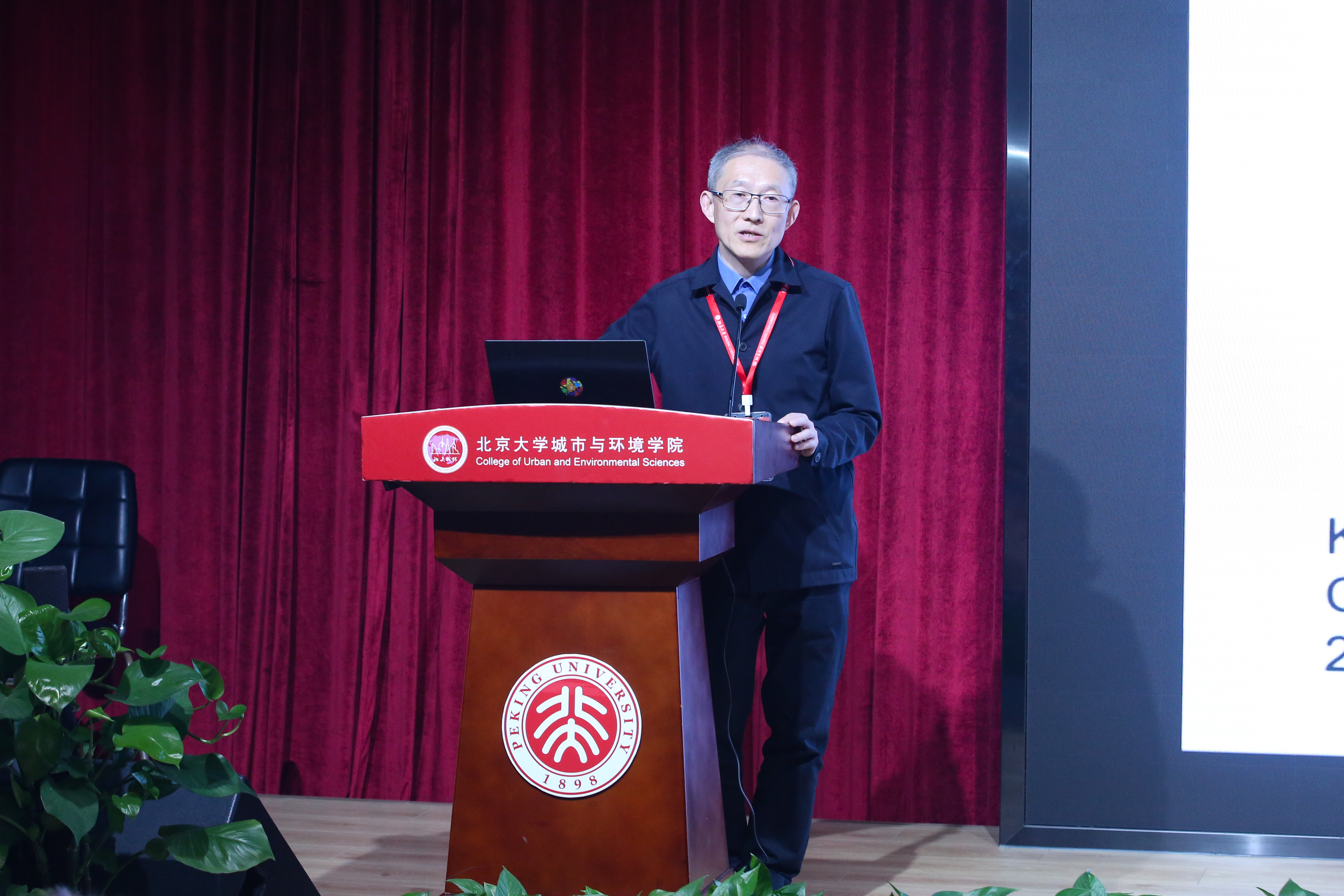
Professor Fulong Wu gave his keynote speech ‘Governing China’s urban development: State entrepreneurialism’. State entrepreneurialism is a midlevel concept coined by Professor Wu to explain China’s urban governance. The concept reveals the importance of grounded and conjunctural theorisation to come up with new theories based on particular context to enrich the mainstream urban and geographical theories. The core idea of state entrepreneurialism is ‘planning centrality, market instrument’, which means that the state uses the market as instruments for statecraft objectives. The typical example is urban (re)development initiated by the central and local governments and performed mostly by local state-owned urban development and investment corporations. State entrepreneurialism complements the mainstream urban entrepreneurialism theory and its different branches and variants. Though the concept is developed based on the Chinese context, it is widely used in other contexts, particularly in the ‘Global South’ where the state plays a key role in leading development.
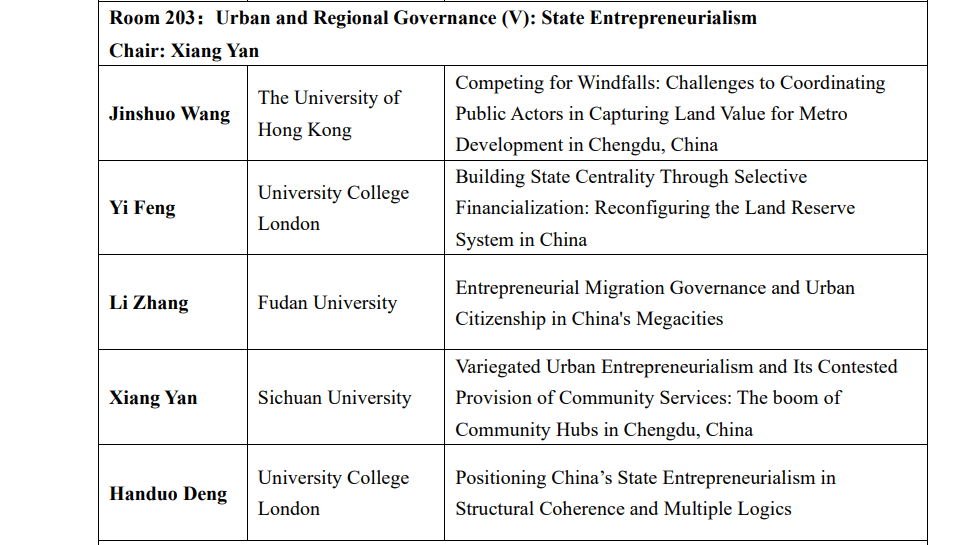
Dr. Yi Feng presented her work ‘Building state centrality through selective financialization: reconfiguring the land reserve system in China’. This paper investigates the reconfiguration of land reserve system and implications for urban governance and financialization based on practices in Shanghai. Through the repositioning of Shanghai Land Reserve Center, project management and funding management and the profitability of land reserve projects, this research demonstrates how local entrepreneurial tactics are affected due to the changing institution. Using China’s case, it illustrates how urban governance and financialization evolves with tensions under changing conjuncture.
Handuo Deng presented her work ‘Positioning China’s state entrepreneurialism in structural coherence and multiple logics’. This research reviews the literature on state entrepreneurialism. It clarifies the theoretical construction of state entrepreneurialism in the historical context and identifies the tension between the structural coherence for capital accumulation and the multiple logics by the state. This research also compares state entrepreneurialism with other alternative studies on Chinese urban governance, thus revealing its structuralist roots of conceptualisation. Its distinctive ontological understanding of China’s urban governance emphasises structural coherence. This research calls for rethinking the evolving structural coherence underlying the strategic reconstruction in the recent decade in which the party-state plays a central role.
 ChinaUrban