
Events
We are organising a series of events including workshops, seminars and conferences to gather thoughts, inspire research and disseminate outputs.
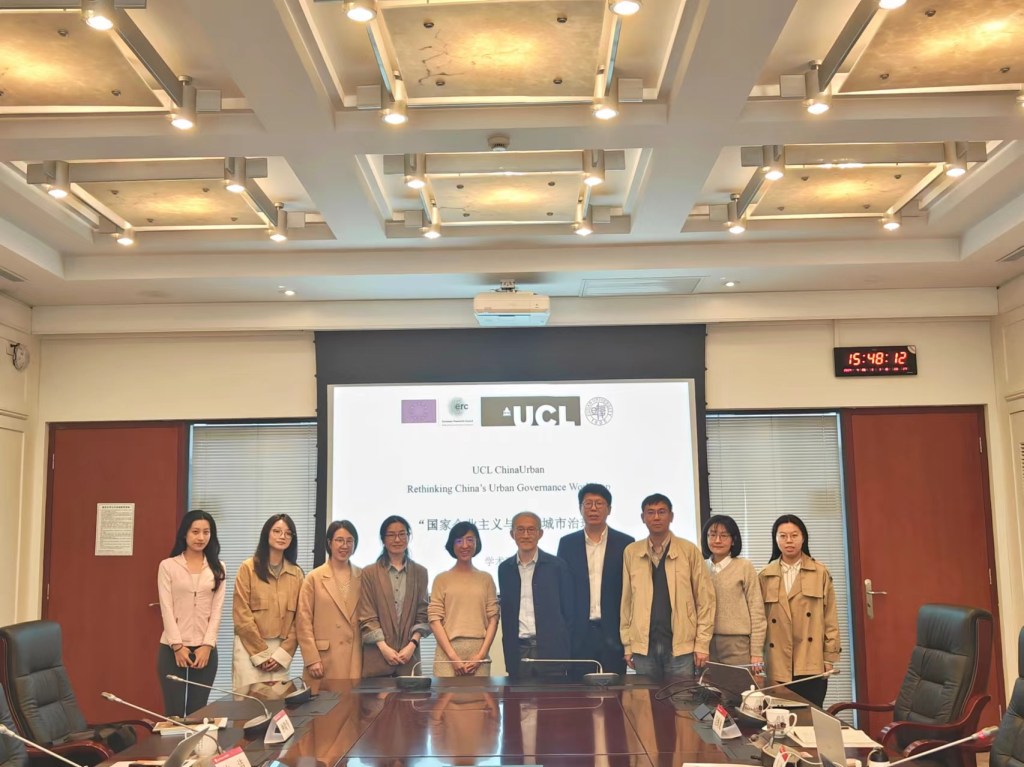
The Rethinking China’s Urban Governance Workshop, Shanghai, China. 26/04/2024.
Funded by the ERC project, The Rethinking China’s Urban Governance Workshop was held at Fudan University, Shanghai on 26 April 2024. Prof. Fulong Wu, Miss Yining Liu, and other researchers in the leading universities and research institutes in Shanghai shared their insights on governance in different aspects.
The workshop aimed to examine the modes of governance in China under the theoretical framework of state entrepreneurialism. The framework emphasises the centrality of the state, including the government at different levels, state-owned enterprises, and other state actors, in governance. State mandates dominate the modes of governance, and the state-market-society relationships profoundly affected by state mandates, which are in salinet contrast with those in the western context, present a valuable research agenda.
Particularly, the challenges brought by the domestic and international actors after the Covid-19 Pandemic directly affect state objectives and hence the governance in China and beyond. As an explanatory framework, the theoretical and practical values of state entrepreneurialism are further highlighted by being capable of explanining the ongoing radical changes.
Based on this, the researchers discussed different realms of governance in China to generate insights for future research and policy making. The programme is as follows.
- Fulong Wu, UCL. The logics of governance: China’s urban governance under state entrepreneurialism (治理的逻辑:国家企业主义下的中国城市治理)
- Tianren Ge, Tongji University. Urban spatial governance under the party-state: The politics of the transformation of urban regeneration in Beijing (政党统合的城市空间治理——北京城市更新的转型政治)
- Yi Li, Hohai University. The modes and effects of the rescaling of in-between cities from the perspective of city-regionalism (城市区域视域下夹缝城市的尺度重组模式与效应研究)
- Xiang Luo, The institute of Planning and Design in Pudong New Area, Shanghai. New wine in old bottles? The governance of commercial rental housing in the urban periphery (旧瓶新酒?城市边缘地区的经营性租赁房及其治理)
- Xiaohua Zhong, Tongji University. The implementation and effects of the planning schemes of five new towns in Shanghai (上海五个新城计划的规划实施机制与治理效能研究)
- Jie Shen, Fudan University. The governance of affordable housing in China (中国城市保障性住房的治理逻辑)
- Tingting Lu, Shanghai Jiaotong University. The entrepreneurial turn in neighbourhood governance: taking ‘group buying’ in the neighbourhoods in Shanghai as an example (探索社区治理中的企业主义转向——以上海社区团购为例)
- Yining Liu, UCL. China’s environmental governance at the neighbourhood level: taking the sustainability schemes in the neighbourhoods in Beijing and Shanghai as an example (中国社区尺度的环境治理:以北京和上海社区可持续企划为例)
The workshop led to productive discussions between the speakers and between the speakers and the audience.
 ChinaUrban