
Events
We are organising a series of events including workshops, seminars and conferences to gather thoughts, inspire research and disseminate outputs.
The Transcalar Politics of Urban Development Conference ‘Making Africa Urban (MAU)’. London, UK. 29/07/2024-31/07/2024.
Prof. Fulong Wu and Handuo Deng participated in The Transcalar Politics of Urban Development Conference ‘Making Africa Urban (MAU)’ from 29/07/2024 to 31/07/2024. They gave talks at plenary and parallel sessions.
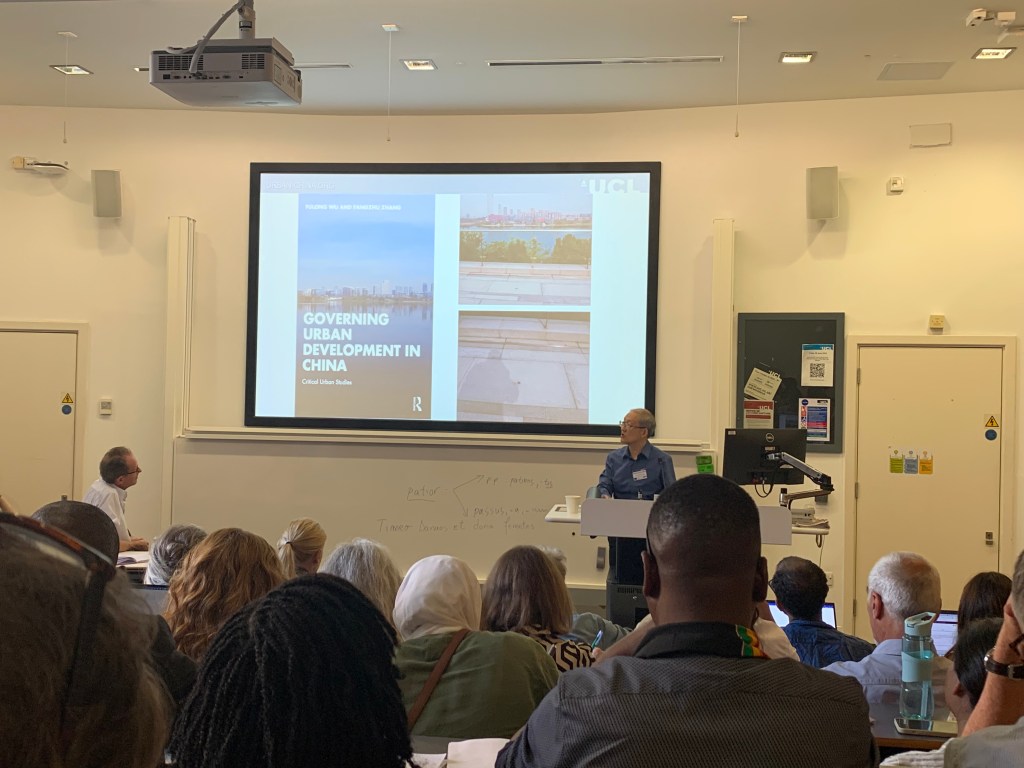
Prof. Wu gave a talk at the plenary ‘Urban Development Politics: Towards comparative conversations’. The title of the talk was ‘Governing China’s urban development: state entrepreneurialism’. It depicted a picture of China’s urban governance and introduced the concept of ‘state entrepreneurialism’ that captures the salient feature of Chinese urban governance. Related to this concept, it discussed relevant theoretical literature on neoliberalism, post-politics, and mega-urban projects, illustrating a new way of governing urban development in contemporary and late capitalism. It also introduced the debate over neoliberal governance and its recent shift under austerity urbanism and financialised governance. Further to this temporal variation, the talk explained geographical variegation by reviewing East Asia’s developmental state and the ‘property state’. The talk expanded the scope of the varieties of urban entrepreneurialism, especially the recent municipal statecraft. It also provided a historical account of changing governance in China and recent research on state entrepreneurialism. It illustrated state entrepreneurialism with examples of China’s large-scale development projects – new towns in the metropolitan peripheral areas. From this perspective, it strived to reinterpret mega-urban projects such as the Corridor of Freedom in Johannesburg. The talk critically reflected on the state’s role in urban and regional governance from these examples.
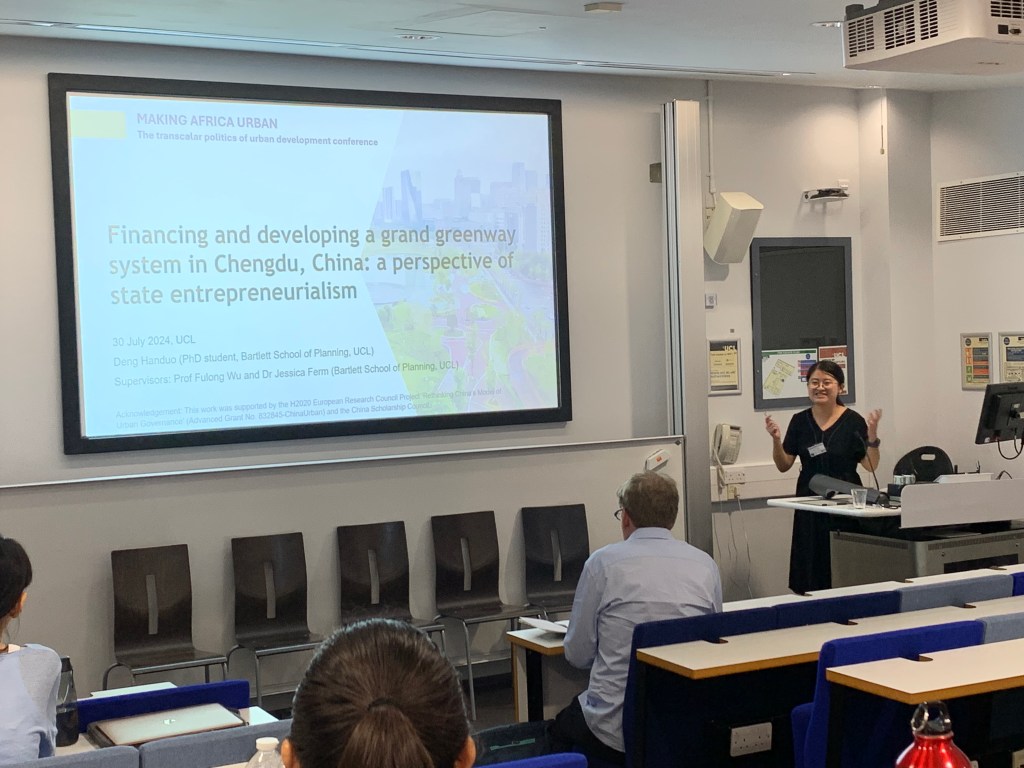
Handuo gave a talk named ‘Financing and developing a grand greenway system in Chengdu, China: a perspective of state entrepreneurialism’. Socio-ecological goals and local growth momentum are often portrayed contradictory in urban development and governance studies. Many urban environmental upgrading projects are critiqued as greenwashing, while visions of enhancing ecological quality and environmental justice are constrained by financing gaps and prone to growth imperatives. The talk engaged with the literature by examining a grand greenway development project in Chengdu, China. As part of Chengdu’s vision of the ‘park city,’ the greenway trails spanned over 500 kilometres and connect 133 km2 of parks, green spaces, and community service facilities citywide. The talk scrutinised state intentionality and approaches to developing and financing the greenway system. It revealed the local party-state leader’s political commitment to the Chinese central state’s ‘ecological civilisation.’ Political aspirations drove the local leader to align with the central mandates of environmental justice and social inclusiveness, making the development rationale beyond value capture. Yet the municipality mobilised a wide range of economic interests, particularly property development, to finance greenways and fused a long-term economic strategy towards green transition. Instead of relying on fiscal funds, it deployed state-owned development corporations to leverage capital market funds, build the greenway, and maintain daily governance. The governance was market-based but different from private governance. Chengdu’s greenway development illustrated state entrepreneurialism. To achieve extra-growth objectives, the state played a dominant role and mobilised entrepreneurial market tools in the grand greenway development. State entrepreneurialism is a perspective from China’s urban development but offers conceptual insights to a wider context. It reveals not only the salient role of the state but also the structural coherence of urban governance with context-sensitive economic development models.
The talks led to productive discussions.


Photos by Zhenfa Li
 ChinaUrban