
Events
We are organising a series of events including workshops, seminars and conferences to gather thoughts, inspire research and disseminate outputs.
Regional Studies Association (RSA) 2023 Annual Conference, Ljubljana, Slovenia. 14/06/2023-17/06/2023
Professor Fangzhu Zhang and Dr. Weikai Wang attended the Regional Studies Association (RSA) 2023 Annual Conference in Ljubljana, Slovenia. Professor Zhang presented her work in a special session entitled ‘Net Zero, Renewable Energy and the Local Economic Development of Regions’. Dr. Weikai Wang presented his work in a parallel session entitled ‘Planning and Designing Regional Futures: What Kind of Planning?’.
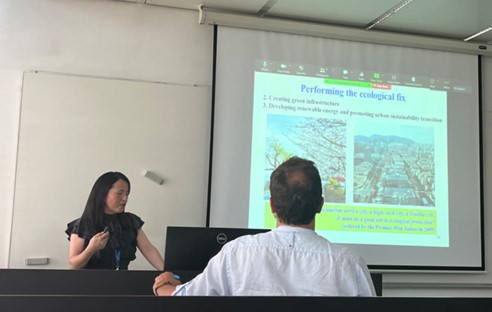
Professor Fangzhu Zhang presented her work about ‘The role of the local government in china’s urban sustainability transition’. This paper adopts a modified framework of the multi-level perspective to unpack the mechanisms of urban sustainability transition in China. Through a case study of the role of the local government in solar development in Wuxi city, it develops two arguments. First, the evolving alignments between niche, regime, and landscape processes of the socio-technical systems of Chinese cities are mediated by conflicts between local governments and their upper-level counterparts as they share power over urban development. Second, instead of being identified as either regime supporters or niche advocates, Chinese local governments are best described as embodying both roles in urban sustainability transition as they struggle to balance their economic and environmental objectives. This research points to a need to examine sustainability transition in Chinese cities with attention to the leadership of the local government in aligning the actions of various actors.
Dr. Weikai Wang presented his recent work ‘Creating city-regionalism at the metropolitan scale: a study of new ‘metropolitan region plans’ in China’. This work investigates the reinvention of metropolitan development in China and highlights new features of recent metropolitanisation promoted by new metropolitan plans. Through investigating extant literature, new metropolitan plans, and interviews with stakeholders, this article distinguishes traditional and new metropolitan development in the form of territorial urbanisation and city regionalism respectively. It illustrates the changes in definition, planning paradigms and governance in two forms of metropolitanisation. The findings provide a nuanced understanding of city regionalism in China.
 ChinaUrban