
Events
We are organising a series of events including workshops, seminars and conferences to gather thoughts, inspire research and disseminate outputs.
Towards a low-carbon city: environmental governance on climate change – A dialogue between the UK and China. London, UK. 02/05/2024-03/05/2024
On 2 May and 3 May 2024, China Planning Research Group from the Bartlett School of Planning (BSP) held the workshop ‘Towards a low-carbon city: environmental governance on climate change – A dialogue between the UK and China.’ The workshop is supported by the UCL-PKU Strategic Partnership Grant (https://www.ucl.ac.uk/global/funding-staff/partner-funds) and ERC advanced grant ChinaUrban (No. 832845) (https://chinaurban.org/). Ten scholars from The Bartlett, UCL and College of Urban and Environmental Sciences, Peking University (PKU) shared their research and insights into strategies and approaches towards more sustainable, low-carbon urban development and governance.
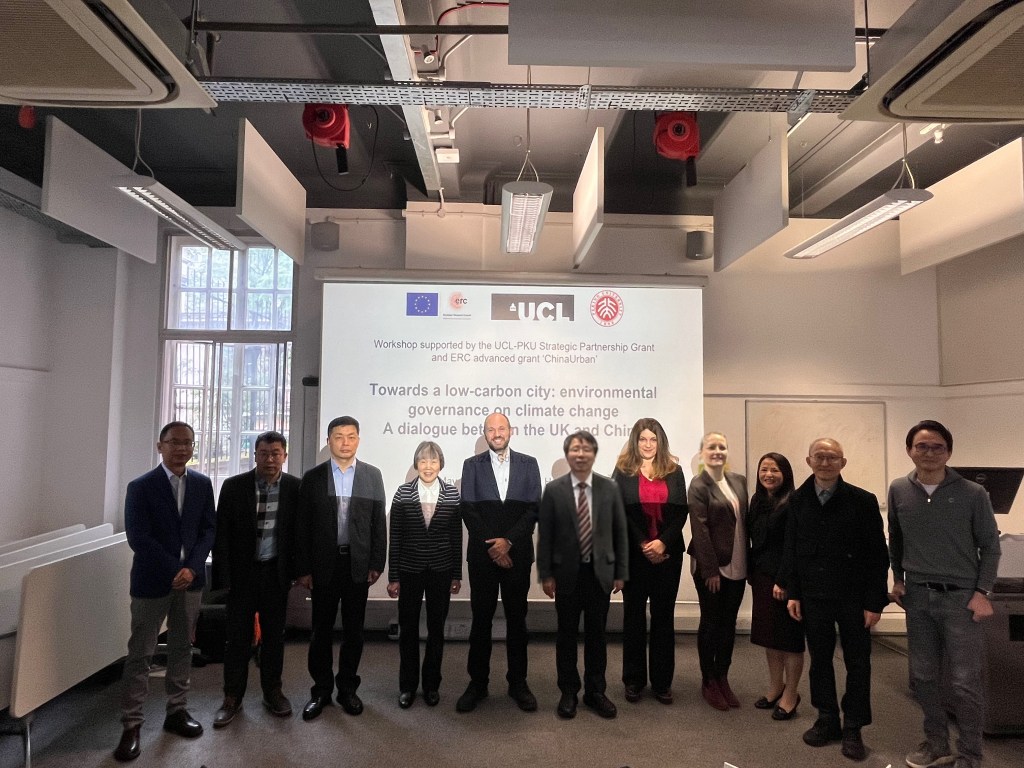
The workshop fosters comparative urban studies through a dialogue between the UK and Chinese experience by identifying best practices, assessing policy transferability, offering tailored solutions, and contributing to global efforts to address carbon emissions and enhance social inclusion in urban industrial development. The comparison contributes to understanding the complexity and diverse pathways of low-carbon transitions. The workshop was also dedicated to collaborating research and education between UCL and PKU.
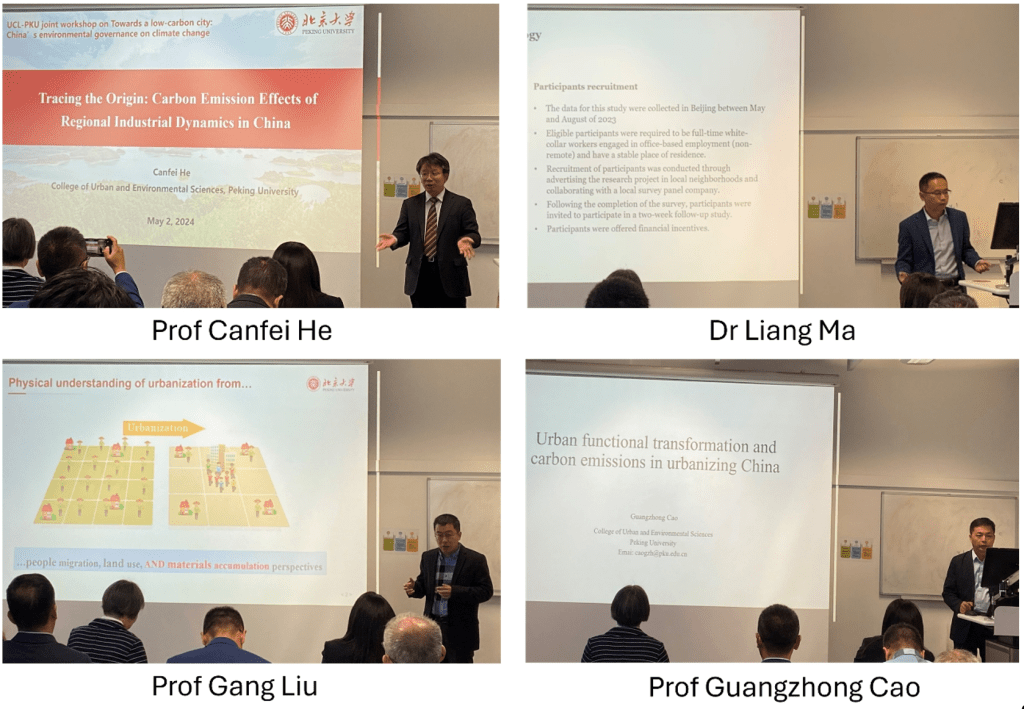
Four speakers from the College of Urban and Environmental Science (CUES), PKU shared their research on industrial, transport, construction, and planning policies and their effects on the low-carbon transition in China and beyond. Professor Canfei He, Dean of the CUES, presented a study on the carbon emission effects of regional industrial dynamics in China, which shows the regional and sectoral disparity in carbon emissions and the significant role of government-driven cleaner production and digital transformation in mitigating carbon emissions. Dr Liang Ma presented a study on the impact of daily commuting on mental well-being in Beijing, China, and contributed to an individual perspective of perceiving effects of sustainable transportation transition. Professor Gang Liu presented a systematic approach to mapping urban built environment stocks at the building, city, national, and global levels. Professor Guangzhong Cao, Associate Dean of the CUES, presented a study on the changing spatial patterns of carbon emissions and the impact of urban function on carbon emissions in China.
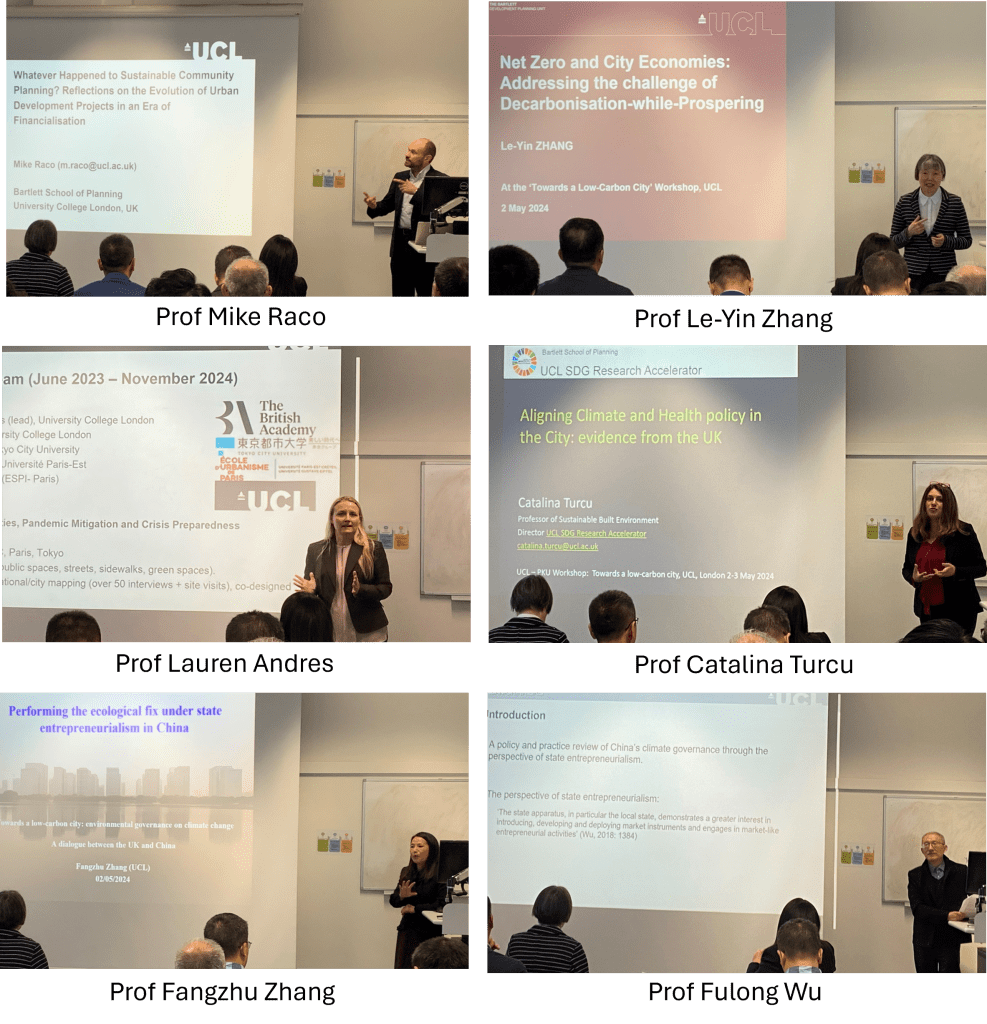
Six speakers from BSP and the Bartlett Development Planning Unit (DPU), UCL shared research on sustainable and low-carbon urban development and governance from diverse contexts. Professor Mike Raco, Head of the BSP, presented on the driving forces of urban development projects in contemporary London and reflected on the dilemma between environmental and financial priorities. Professor Le-Yin Zhang from the Bartlett DPU resonated with the dilemma and discussed the relationship between the Net Zero agenda and the city economic growth based on cities’ response globally. Professor Lauren Andres from BSP presented key research insights and agendas on cities’ adaptability and resilience to socio-ecological crises, such as the COVID-19 pandemic and climate change, based on her research in North America, Europe, and Asia. Professor Catalina Turcu from BSP discussed the significance of governance frameworks that co-benefit climate-resilient infrastructure and health-promoting initiatives from local and national perspectives in the UK. Professor Fangzhu Zhang from BSP presented a study on how Chinese local states have pursued eco-environmental goals by performing the ecological fix beyond growth agendas, based on a case study of Taihu New Town in Wuxi. Professor Fulong Wu from BSP presented a comprehensive policy review on climate governance by Chinese central and local states, including the state intentionality and governance approach to achieving national strategies.
Photos credit: Weikai Wang, Zhenfa Li, Handuo Deng
 ChinaUrban